Solar Energy Tracking System using microcontroller
Abstract of Solar Tracking System:
The goal of the project is to
develop and implement a solar energy tracking system using a microcontroller. To
find out alternative sources of energy and get maximum efficiency from such
non-conventional energy source is the need of present and future. This project
involves around the requirement that how we can design an efficient solar panel
system to acquire maximum solar energy from it. This is the reason we are try
to design this project.
Introduction of Efficient Solar Penal System:
As the energy costs are
increasing with the decreasing supplies of conventional fuels, the need arises
to find out sustainable alternative forms of power. These energy source shall
be such that to protect the environment from the harmful releases of gases. The
Solar energy is one of the big sources which is being implemented. The Solar
panels are usually fixed at certain angle, although a reasonable amount of
energy is produced from these panels. But production of electricity can even be
increase with the use of an intelligent solar panel tracking system which
control the direction solar electrical panel in a way to face the sun at the maximum
time. If we design a system which control the solar electrical panels such that
it always faces the sun, then we will be able to get maximum advantage from sun
light with the use of existing solar panels. This microcontroller project involves a solar
tracking system which is designed with a microcontroller, optical sensors and
motors. The position of sun and panel is checked and best suitable direction is
calculated then the panels are moved in such direction that panel should face
the sun exactly. The position or directional angle with respect earth of the
Sun is not fixed. Therefore the angle at which sunlight strikes the earth
surface also varies through the day. Therefore the solar panel will have
variable amount of light whole the day. The production of electrical energy
will also be not constant. So the direction of solar panel need readjustment
through the day in order to have sun facing angle, so that maximum light may
fall on solar panels. All this happening due to the rotation of the Earth
around the sun in our sun solar system. The Solar-electrical panels shall
absorb sunlight maximum to give maximum electrical energy. It can only be
achieved if the solar-electrical panels are incessantly moved and placed inline
with direction of the Sun to have maximum sunlight all the time. Therefore the
solar-electrical panel will be constantly subject to adjustment-readjustment
rotational angle as a function of direction of Sun. This microcontroller
project is designed to obtain the desired goal for having maximum efficiency
from existing solar-electrical system with applying tracking algorithm.
Solar Panel for Maximum Electrical Energy Tracking System Objectives:
The main objective of the
project is to design a solar tracking system using pic microcontroller. However
besides this we will achieves some associated advantages like we will be able
to learn about the working of the solar energy panels tracking system, implementation
of a microcontroller from PIC family to achieve the target, the needs of a solar
energy tracking system, the appropriate methods of tracking the solar energy
generating panels used, the design methodology and constraints in the
development of efficient solar panel tracking system, the designing of schematic
circuit diagram of tracking system using microcontroller from the PIC family, writing
the software and code listing for the PIC microcontroller in the construction
of an efficient solar panel electrical tracking system.
The Philosophy of Solar tracking system:
The solar energy converting
electrical panels tracking system works with on an idea to get the maximum energy
from the existing solar to electrical panels with implementation of a smart
electronics controller with the solar panels. It is already in understanding
that the solar panels are installed at the roof of the house or any other
building with the intension to get the electrical power from the light and heat
of the sun energy with the help of these solar-to-electrical panels. It is
worth mentioned that the solar-electrical panels convert solar energy into
electrical energy with an effective implantation of photovoltaic principle. It
is very obvious that the intensity of light from the sun plays the important
role in the production of electrical energy from the panels, more electrical
power with higher intensity of light. Is
there any other factor which can serve to obtain more electrical power from the
solar-electrical panels? Yes the direction of placement of panels is much
important, the panel shall be placed in a suitable direction that maximum light
from sun can fall directly on the panels. This project is designed for the
controlling the position and direction of solar-electrical panel in such a way
that the light from the sun fall directly on panels and maximum energy may be
converted and obtained. Therefore here we will be developing a controller of
panels to rotate them accordingly with the hanging the position of sun.
By using this tracking system,
we will be able to expose solar panel for the maximum time in front of sunlight
and thus we will be able to get the maximum power from the existing solar
panels. There are two well pronounced methods which are used for the Solar
tracking system. These are the Sun-Solar tracking system and Time-Solar
tracking system. These two methods are briefly explain below.
Time solar tracking system:
The information of time and
season is additionally gathered from the database to find out the exact
direction where the sun light is maximum. In this method time plays an
important rule to decode the rotation of earth around the sun. The use of real time
clock in the control circuitry of solar tracking system with microcontroller
will do the purpose. As the season give different angles of direction where
sunlight is more than usual. Therefore the tow parameters together will decide
it.
Sun Solar tracking system:
The solar tracking system, as
its name indicates that it will track the sun. The solar panels rotated with
the help of motors in the direction of sun. As the quantity of light changes
with the rotation of earth around the sun, therefore it is necessary to measure
the intensity of light. The Light dependent resistor (LDR) or photo diode are
used for this purpose. The electrical signal generated by optical sensor is
processed and command to motors is issued in response. As a result the solar
panels gain the direction where the light is maximum.
The optical sensors which will
be either the LDR or the photo diode or photo transistor will measure the
intensity of light. There are two optical sensors used which are separated by
an insulator of light, so that each may work independently. Initially both
sensors are calibrated when same amount of light is given to each of them.
After their installment at the panels, now the light intensity from each of
optical sensor is measured using the microcontroller. In ideal conditions when
same amount of light falls on both sensor, they should give same amount of
electrical output and the motor shall not move in any direction unless one of
the sensor start giving less or grater light. With the start of day, the output
of sensors will not balance each other therefore microcontroller will generate
command to motors to bring the panels in the direction of sun, where the light
is maximum and both optical sensor read equal amount of light. Following are
test cases of project:
Case # 1: When the electrical
signal from both sensor is same, reflecting that the intensity of light is same
at both optical sensors. In this case the solar-electrical panels will be
assumed that the direction is perfect and there is no need to rotate in any
direction. Solar panel will remain in this position.
Case # 2: When the output of
the optical sensor is not equal. The optical sensor # 1, which is on left side
of panel reads more intensity than the sensor # 2 which is at right side of the
solar panel. It will happened usually in the morning time, left optical light
sensor will be on higher intensity. Then solar panel will start rotating will
the help of stepper motor to left direction where the two sensors get same
reading of intensity. It will be the point where maximum solar light will fall
on the solar panel and out optimum direction.
Case # 3: When the output of
the optical sensor is not equal. The optical sensor # 2, which is on right side
of panel reads more intensity than the sensor # 1 which is at left side of the
solar panel. It will happened normally afternoon, when the right side optical
light sensor will be on higher intensity as compared to the left side optical
sensor. Then solar panel will start rotating will the help of stepper motor to right
direction till the two sensors have same response. Then we get our desire direction
where maximum solar light will fall on the solar panel.
The 2-D solar tracking System:
The Solar energy is also
called free source of energy that’s why it has gain more popularity as compared
to other renewable energy resources. Moreover the emission of burned fossil
fuel bi-products and hydrocarbon which are destroy our environment are not
associated with the power generation from the solar system. The
Solar-electrical named as Photovoltaic (PV) panels are the devices which convert
the sun light into electricity energy. Once a solar system is planned to
installed anywhere for the generation electricity from sunlight, then the point
of concern come that the maximizing electrical shall be acquired to increase the
efficiency of solar system at the available resources. To achieve this goal the
solar or photovoltaic panels must be kept aligned with the direction of sunlight
through the use of a tracking system which will focus on the direction of the
sun.
It is learnt that the efficiency
of PV panels is a function of various parameters like environmental
temperature, humidity, rain, status of cloud and dust level on panels. This
project is a Microcontroller based two axis Solar Tracking system which adjust
the direction of solar panel so that the efficiency of solar panel is increased
considerably.
Components used in the development of general purpose one axis solar tracking system.
If we wish to develop a low cost general purpose one dimensional solar tracking system then we will have to build a few components like Solar panel, PIC18F452 microcontroller, Optical sensor based on Photo Transistors or photo diode, A set of resistor, Servo Motor, 8MHz Crystal, 22pF Ceramic Capacitors, Connecting Wires, Stepper motor, ULN2003, Oscillator, Resistors, Capacitors etc.
Construction of Two Axises Solar Tracking System:
On the implementation of the tracking system, we will be considering the direction of the sun which will be varying in two directions up-down and left-right. The horizontal direction from the observer to the sun is called the azimuth angle. Whereas the vertical direction from the observer to the sun is called altitude angle.
Schematic Circuit diagram of the Two-Axis Solar Panel Tracking system using microcontroller PIC 18F452:
The Schematic Circuit diagram for double axis solar tracking system has been designed, prepared and analyzed in Proteus ISIS software. The full circuit of 2-D solar panel tracking system is shown in Figure # 1.
 |
| Figure # 1: Complete Circuit diagram of 2-D Solar Tracking System |
The whole schematic circuit diagram of the project is consisting of following main sections:
1. The central processing Unit Board CPU consisting of PIC Microcontroller 18F452
2. The Sensor Boards consisting of Temperature sensor LM35 and optical sensor LDR.
3. The Keyboard consisting of four push switches and a latched button.
4. The LCD based display Unit Board
5. The Motors controller boards
6. The LED status board
7. The power supply section
The details of component and construction of each section and its board is discussed as below. The functionality of whole project will be explored step by step as under.
Solar Tracking System Central processing Unit Board (CPU)
For the processing of information gathered from the sensors and obtaining the useful results for the effective control of DC motors, the CPU boards is designed, as shown in the diagram (Figure # 2) below.
 |
| Figure # 2: Microcontroller PIC18F458 Connection with circuit diagram of solar Tracking system |
The tasks done under this brain board of the solar tracking system developed using Microcontroller are listed as under:
The components used in the CPU boards, the brain and heart of the solar tracking system, which is the main processing board and act as the essential electronics board of project are listed as below:1. Measuring the signal from the optical sensors (04 Nos). The four optical sensors (LDR) are required to mount on each side of solar panel i.e to detect the light intensity at Upper side, lower side, right side and left side. The Light intensity signal is processed by converting the analog voltage level to digital by using built-in ADCs of the Microcontroller. The digital number corresponding to light intensity levels at each side are formatted properly to be utilized effectively in the logic decision section of program.
2. Measuring the analog signal from Temperature sensors (QTY: 04 Nos). The four Temperature sensors (The Integrated Analog Temperature Sensors LM35) are required to be mounted on each side of solar panel i.e to detect the Temperature at Upper side, lower side, right side and left side. The analog signal from LM 35 is processed by converting the analog voltage level to digital by using built-in ADCs of the Microcontroller. The digital number corresponding to the degree of Temperature at each side are formatted properly to be utilized effectively in the logic decision section of program.
3. The sensing to keyboard which is consisting four directional keys i.e. up-ward, down-ward, left and right side keys. These keys are used to the manual motion of solar panel (if required).
4. The scanning of a logical latched button which used for the selection of Logical decision, whether the decision should be based on results of Temperature sensors or optical sensors, or otherwise the logical decision will be based on results of Temperature sensors and optical sensors. This selection is very important in decision matrix. Because there will be location where we will be preferring to utilized the optical sensors as input only for the implementation of proper direction of solar panel. In this case the temperature reading will be ignored in making the decision of motion. In other condition we will preferably utilized the results from both type of sensors and if logic from both sensors is in same sense, then motor will be operated accordingly to adjust the direction of solar panel.
5. Updating the LCD display with the current measured values of the four temperature sensors and four LDR, the optical sensors at the LCD. The user will have to look if he wants to know what are the temperature and light intensity levels at various sides of the solar panel. Is the controller is working perfectly or algorithm shall be modified.
6. The issuance of movement commands for each motor separately when required for the adjustment of solar panel UP-DOWN (Vertical Movement) direction and Left-right direction (Horizontal Movement). There are two motors which are responsible for the 2D axis adjustment of the solar panel in right direction and angle.
7. The main program will be performing the calculations and producing the proper commands for motor control (if required). It will be discussed in more details in the Logical decision making section.
1. The PIC Microcontroller 18F452. It is selected for three reason that the ADCs results of this microcontroller are stable. Secondly, the number of IO lines required for this project meets by using the PIC 18F452 Microcontroller. Third reason for the selection of this microcontroller is that it has sufficient RAM, ROM to support the software requirements of this solar tracking system.
2. Crystal 8 MHz: The 8 MHz crystal is very optimum choice, how ever the project can easily work on the 20MHz crystal as well. There is any number in between 8 and 20 MHz crystal will efficiently work.
3. Capacitor 33pF (QTY: 02 Nos)
4. Resistor 10k Ohm
5. Capacitor 104 mounted on power supply lines. Although it is not shown in the schematic diagram, but is sued because the Power supply are not visible or shown in circuit diagram prepared in the software Proteus ISIS.
6. Capacitor 100uF 16V mounted on power supply lines. Although it is shown in the apparent circuit diagram, but it is recommended to be used in parallel with the power supply lines to have a good filter power supply to microcontroller.
Sensor Boards:
There are four sensor boards
used in the project of solar tracking system using microcontroller PIC 18f452.
Each board has one temperature sensor and one Optical sensor as shown in figure # 3. The temperature
sensor we are using in project is an integrated analog temperature sensor LM35
which is good for general purpose applications and its response is also
acceptable. It gives analog output signal 10mV/degree C. The optical sensor is
LDR, whose resistance varies with the intensity of light. When light strikes on
the LDR sensor, then the resistance of the photo sensor decreases. It means
that during day time its resistance will be low in the order of a few hundred
Ohms (400 to 500 Ohms) and in night its resistance will be high in the order of
a few kilo Ohms (1400 to 1500 Ohms). In the day time its resistance will be
function of amount of light falling on it in the range of say 150 Ohm to 700
Ohms. Thus potential difference across the LDR will be direct presentation of
the intensity of light. If there is less light strike on it, its resistance
will be high and voltage drop across it will be lower and vice versa. The two
analog signals from each board are feed to the ADC (Analog PINS) of the
Microcontroller PIC 18F452. Where the analog signal is then converted to
digital signal and processed accordingly.

Figure # 3: Placement of sensor at solar panel for sun tracking system using Microcontroller PIC18F452
Keyboard
A small keyboard consisting of
four push buttons and latches button is designed and attached with the
microcontroller board to accept the input from users. The reason of this
keyboard is to facilitate the user of solar tracking system to give manual
commands to microcontroller for the proper fixing of location or direction of
solar panel. The circuit diagram of the keyboard is presented in figure # 4 as below.
It is consisting of simple
push button which are pull-up with 10kOhm resistor for the generation of proper
logical signal. When any of the key is press, a corresponding logic “0” is
obtained otherwise due to pull-up resistors the logic “1” will be on each
switch output line. The four push button corresponds to provision of input for
movement in four direction like up, down, left or right direction of solar
panel for the fine adjustment if required by user.
 |
| Figure # 4: Key Board Interfacing Circuit diagram with Microcontroller for Solar tracking System |
One latch switch or button is
provided at keyboard front panel for the selection user intension for logical
decision regarding the direction of panel. The facility is provided to use
optical sensor input with logical or with temperature input. At the other
position of switch, it will logical and the inputs of the temperature sensor
and optical sensor. Thus in this selection case, the decision will consider the
input from both sensors, if it is coincide then movement command will be
generated.
LCD based display Unit Board
An LCD of four line and twenty
characters is used for the display of the current temperature and intensity
levels on the screen front panel. The LCD is interfaced with microcontroller
using four bit mode. The total six IOs lines of Microcontroller are used for
the data and command communication between LCD and microcontroller as shown in figure # 5 below. Four IOs
lines are for data and two IOs lines for control line to give LCD enable signal,
and RS signal to LCD. The LCD is used in fixed write mode. The contrast of LCD
is controlled using a potentiometer, variable resistor, of 10kOhm. The LCD will
work on DC 5V power supply which will be shred from microcontroller board power
supply section.
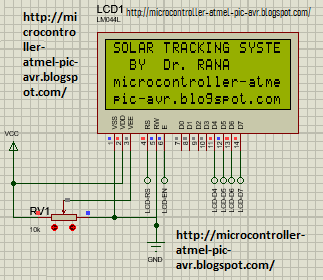 |
| Figure # 5: LCD Display Connection with circuit diagram for solar tracking System |
Motors controller boards
There are two DC Motors
required to be used in this project of solar tracking system using
microcontroller PIC 18F452. Therefore there are two motor control board
designed to control one DC motor by each motor controller board. Each Motor
control board I consisting of four transistors, two PNP and two NPN
transistors. The Four transistors are configured to make the well know H Bridge
type control of DC motor as shown in figure # 6 below. The PNP transistors are responsible for the provision
of positive power supply connection to motor one terminal. On the other hand
the NPN transistors are responsible for the provision of ground level voltage
to the other terminal of the DC motor. As we know that the PNP transistor is
active or start conduction when operated as switch on the availability of logic
“0” on its base terminal. Whereas the NPN transistor when configured in switch configuration
will be active on the provision of logic “1” at its base. One PNP and one NPN
transistor share one IO line. Therefore at a time only one transistor will be
active. Thus for the effective control the direction of motion of DC motor, two
control IOs of microcontroller are used. At idle time, both IOS will have same
logic level. But for motion in particular direction i.e. clockwise or
anticlockwise, the logic level on one IO line will be high whereas logic level
on the second IO line will be low. Therefore at this time one PNP and one NPN
transistor from opposite in diagonal when conduct, as result one terminal of DC
motor will receive positive supply and other end of motor will receive ground
level. Then the motor will start rotating till the change of status of IO
lines. The Four PN junction protection diode are also used in the motor
controller board to nullify the reverse emf generation problem of DC motor.
These diode are for the safety of transistor because otherwise transistor may
burn out on the generation of reverse emf at the terminal of motor.
 |
| Figure # 6: MOTOR DIRVE CONTROL Circuit diagram of Solar Panel Tracking System |
It may be noted that the
specific number of PNP and NPN transistor and diodes are not being mentioned
with the intension that the user may select the components to meet the
requirement of load, DC motor specifications etc. Therefore the power supply of
DC motor will also be appropriately selected on the basic of requirement of DC
motor.
LED status board
A board is designed to show
the movement of solar penal if any motor is operated at any time with the help
of four LEDs which corresponded to the movement of direction in four side. The
same IOs lines used for the control of direction of rotation of motor used by
motor controller boards are used here to glow the respective LED with the
utilization of TTL IC, 7408 and 7404, AND gate logic IC and NOT gate logic IC
respective as shown in the figure # 7 below.
 |
| Figure # 7: LED Status Board for Motor Motion Indication |
Power Supply Section
Apparently the microcontroller and associated boards works with regulated DC 05V power supply which is consisting of a step down transformer, rectified diodes, filter capacitor and an analog voltage regulator LM7805 IC. As the overall current consumption of the circuits is not high and remains in the range of about 100mAs to 150mAs. Therefore use of LM7805 IC is enough which is usually cable to provide 1000mAs regulated power supply. However the DC motors selected for this prototype project works on DC12V and may draw current in the range of 1Amp. Therefore a spate power supply for the motors will be required to match the requirement of motors. As we are not fixing the selection of motor at this stage therefore the user or developer is responsible for the section of appropriate DC motors and their power supply along with the proper selection of PNP & NPN transistor pairs in the motor controller board. This end is kept open and component can be selected based on the actual requirements.
Software of the 2-D solar Tracking System Using Microcontroller PIC 18F452:
The program coding of the 2-D solar tracking system is written and compiled using Proton Plus Basic Complier for PIC Microcontroller. Its code listing is provided in the next post. Please visit the Post " Program for Solar Tracking System".
The other microcontroller based degree projects and many hobby projects of Microcontroller are available here.


